
Retaining Wall Repairs and Replacement in Brisbane
The wall has moved, and you cannot tell whether this is a weekend of work or a rebuild. The symptoms are more diagnostic than most people realise.
Reading what the wall is telling you
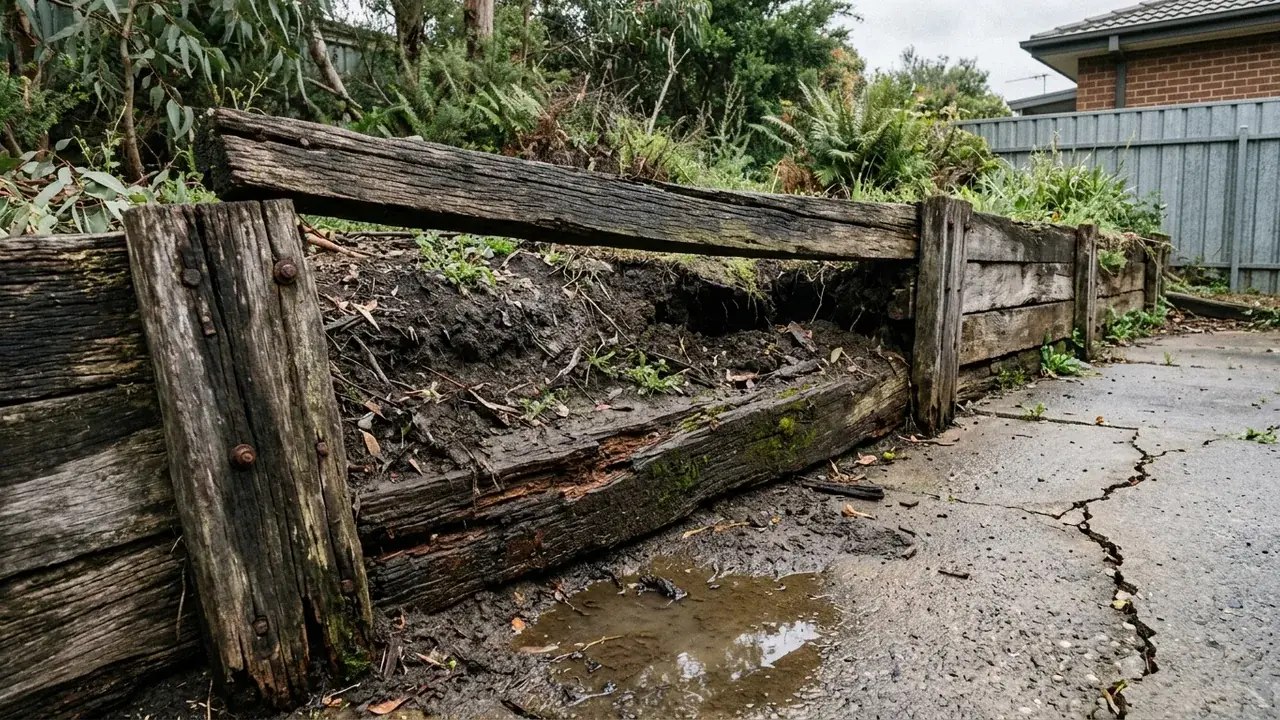
This is the enquiry that comes up more than any other on Brisbane blocks, and it starts the same way. The wall leans a little further each wet season. Sleepers have bowed between the posts. There is soft timber at ground level, soil dropping away behind the top, water pooling at the base after rain, sometimes a crack in the path running parallel to the wall.
Every other page here assumes the decision to build has been made. This one sits upstream of it. Before material, before price, the question is whether you are buying a localised fix or a replacement, and the difference between those two answers is large. The symptoms above sort into two groups fairly reliably, and knowing which group yours belong to changes the conversation you have with anyone who quotes.
Retaining Wall Repairs and Replacement Work
Failure assessment
Working out whether movement is localised or general, whether posts are sound at ground level, whether the wall has passed its service life, and whether water is the underlying driver rather than a symptom of something else.
Drainage remediation
Where a blocked, silted or absent subsoil system caused the failure, fixing the drainage is the repair. Rebuilding a wall onto the same undrained backfill hands the new wall the conditions that broke the old one.
Full wall replacement
Removal of the failed structure, spoil handling, and a new wall built to current requirements. Approval and engineering are assessed fresh, because a replacement is new building work rather than a continuation of the old one.
Partial rebuild and section replacement
Where damage is confined to one bay or one end of a long run, replacing that section can be viable if the rest of the structure and its posts are genuinely sound and the ground behind is stable.
Symptoms that point to repair, and symptoms that do not
Localised damage tends to be repairable. One cracked block, a single bowed sleeper in an otherwise straight run, a section that has moved where a downpipe discharges, surface damage that has not changed in years. These are usually specific causes with specific fixes, and drainage is frequently the specific cause.
General movement is a different conversation. A wall leaning consistently along its whole length, posts that are soft or spongy at ground level, bulging concentrated at the base of the wall, soil visibly dropping behind the top over a season, or a wall known to be forty or fifty years old and built in timber. That combination is a wall at the end of its life rather than a wall with a problem.
The middle ground is real and worth being honest about. Sound posts with rotted boards is a genuine repair. Rotted posts with reusable boards is not, however tempting the arithmetic looks, because the posts are the structure. Nobody can settle which case you have from a description alone, which is why the useful next step is having someone qualified look at the ground line rather than the face.
Why replacing costs more than building new
People are routinely surprised that a replacement wall is dearer than the same wall on a clear site. The reason is that a replacement carries a demolition job in front of the construction job. The old wall has to come out, the material has to leave the site, and spoil removal on a sloping suburban block is rarely quick.
Then there is what the excavation reveals. Drainage remediation is common on a replacement because the original system either never existed or has silted up, and that work happens after everything is already open. Access is usually worse than on a new build too, since the house, the garden and the driveway are all already there and a machine has to work around them.
For orientation only, indicative material bands sit around $300 to $450 per square metre of wall face for timber sleeper and around $550 to $700 for concrete sleeper, before GST, and excavation alone can add roughly $400 to $1,500 or more. Demolition, spoil and drainage remediation sit on top of that. These figures are indicative and a written quote that itemises removal, spoil, drainage and the new wall separately is the only way to see the real shape of the job.
If the wall has moved suddenly
Most retaining wall problems are slow and planned work is the right response. There is one exception worth stating calmly: a wall that has moved noticeably in a short period, or that is bulging hard at the base, is behaving differently from one that has crept over a decade.
The sensible response is practical rather than dramatic. Keep people away from the downhill side and off the ground directly above it, stop adding load above the wall, and divert any obvious water source running into the backfill if you can do so safely. Then get someone qualified to look at it rather than waiting to see whether it settles.
What no website can do is tell you whether your wall is safe. That assessment needs someone on site, looking at the ground line, the base and the soil behind. Boundary walls raise a separate question about who is responsible for what, which depends on location, purpose and any agreement in place, and is worth settling before a repair is priced.
From a leaning wall to a decision
- 1
Photograph the ground line
Most of the diagnosis lives at the base, not the face. Photos of the bottom of the posts, the soil behind the top of the wall, and any pooling after rain say more than a photo of the wall from the lawn.
- 2
Establish whether water is the cause
If there is no drainage behind the wall, or the discharge is blocked, that is likely the driver of everything else. It changes the scope of the repair and it has to be fixed regardless of which option you take.
- 3
Decide repair, section or full rebuild
Sound posts with damaged boards, one failed bay, or general movement along the run lead to three different jobs with three different prices. This is the fork the whole quote depends on.
- 4
Reassess approval for the replacement
A new wall is new building work, so the five Queensland triggers are checked again rather than inherited from the old wall. An old wall built without approval does not set any precedent for its replacement.
Being straight about repair versus rebuild
The honest split is stated up front
Localised damage, minor movement and drainage problems can often be repaired. Rotted posts, sustained lean along the run and a wall past its design life point at replacement. Being told which one you have, with the symptom that decides it named, is more useful than being told either answer immediately.
Brisbane timber stock is simply old
A great deal of the interwar and post-war housing across Ashgrove, Holland Park, Coorparoo and Camp Hill sits on hand-cut benches held by timber walls now thirty to sixty years old. Many of those walls are not failing from poor workmanship. They have reached the end of a normal service life.
Nobody here can tell you it is safe
Assessing whether a moving wall is dangerous requires someone on site with the competence to judge it. Describing what you are seeing accurately and knowing what to ask is genuinely useful, but it is not a substitute for an inspection by a qualified person.
Working through the options? The concrete sleeper retaining walls and engineered & council-approved retaining walls pages cover the two nearest alternatives, and the cost calculator puts an indicative band against each of them.
Repair or replace, answered honestly
How much does a retaining wall cost in Brisbane?
How much does a 10m retaining wall cost in Brisbane?
Do I need council approval for a retaining wall in Brisbane?
Do I need engineering for a retaining wall in Brisbane?
What is the cheapest type of retaining wall?
Ask a question about your failing wall
Describe the lean, the age, the material and what happens at the base after rain. Photos of the ground line help more than anything else.
Retaining Wall Repairs & Replacement across Brisbane
Terrain, access and building stock change what retaining wall repairs & replacement look like from one part of Brisbane to the next. Pick your suburb for the local notes.
Diagnosing a failing wall
Get a written quote for retaining wall repairs & replacement
Send the height, the length and what sits above the wall, and you will get a written response covering retaining wall repairs & replacement.