
Rock and Boulder Retaining Walls in Brisbane
You have a big sloping block backing onto bush or a creek, and a hard grey sleeper wall would look wrong on it. Natural stone sits into that setting properly, but it asks for room and machine access in return.
Choosing stone for how the block reads
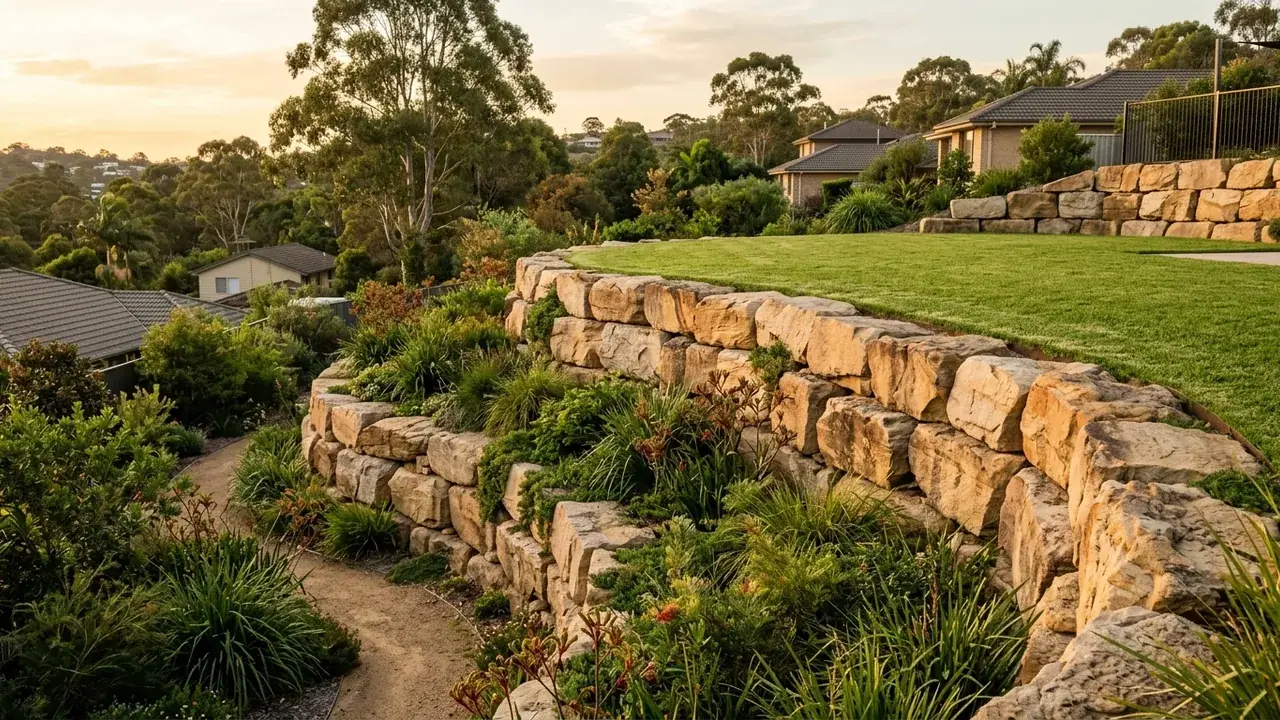
This is the one wall type people choose with their eyes first. On the larger blocks around Kenmore and Chapel Hill, on frontages with a rural feel, and along the creek margins near Cubberla, Moggill and Bulimba Creeks, a battered stone face reads as part of the ground instead of a line drawn across it. Sandstone blocks give a squared, coursed look; irregular boulders give something rougher that plants can grow through.
The honest catch sits in the geometry. Batter means the backward lean built into the face for stability, and on a stone wall that lean is significant. A wall that leans back is a wall that occupies floor space at the bottom of your slope. So the useful conversation here is not only which stone, but how much of the flat ground you were hoping to gain the wall is going to take back.
Sandstone, Boulder and Natural Stone Work
Sandstone block walls
Quarried sandstone cut to regular block sizes and laid in courses with a set batter. It gives a warmer, more formal face than raw boulders and suits walls that sit near the house rather than out on the boundary.
Boulder walls
Large natural stones placed individually by machine, keyed into each other and battered back. Every stone is a placement decision, which is why boulder work is slower per square metre than the raw material price suggests.
Natural stone landscaping
Steps, garden edges, dry-stacked terraces and creek-edge treatments in the same stone as the main wall, so the retaining reads as one piece of landform rather than a structure with decoration around it.
Batter setout and footprint planning
Before any stone arrives, the lean and the base width are marked on the ground. This is where you find out whether the level area you wanted survives the wall, and it is much cheaper to discover on a string line.
Why a Rock and Boulder Wall Is Not Automatically the Cheap Option
On material rate alone, stone looks like the bargain of the group. Indicative bands put rock and boulder work around $150 to $300 per square metre of wall face, well under sleeper or block systems, before GST, excavation, drainage and access are considered. Read that number in isolation and you would build every wall out of stone.
The number moves for two reasons. The first is plant. Boulders are placed by excavator, and if the machine that can lift the stone cannot reach the wall line, the job either gets smaller stone, longer handling or a bigger machine, and all three cost. The second is footprint. Batter means the wall base is wide, so excavation volume and spoil removal are larger than for a vertical wall of the same height.
Which is why stone is genuinely economical on open sloping blocks with a driveable approach, and genuinely awkward on a narrow inner-city site with a side gate for access. The rate is indicative and the site decides the rest, so a written quote that prices access and spoil separately is what tells you which of those two you own.
Free-draining is not the same as drained
Stone walls pass water through their face, and that is a real advantage: water does not build up behind a wall it can walk straight out of. It is also the source of the most common misunderstanding about porous walls. A porous face does not remove the requirement for designed subsoil drainage behind the wall, which is a code requirement under QDC NMP 1.7 rather than an optional extra.
What a free-draining face changes is the consequence of a partial blockage, not the need for a system. Behind the stone there is still clay backfill that will hold water, still fines that will migrate, and still a need for a collected line running to an approved discharge point rather than water simply appearing wherever the slope allows. Geofabric between the backfill and the drainage gravel is what keeps the clay out of it.
There is a boundary dimension too. Water leaving a stone face has to go somewhere legal. Concentrating stormwater onto a neighbouring property is not acceptable regardless of how the wall is built, and on a creek-adjacent site the discharge arrangements deserve a specific answer rather than an assumption.
Placing a stone wall on a sloping block
- 1
Read the slope and the sightlines
Where the wall sits, how it curves, and what it will look like from the house and the street. Stone walls are usually seen from above as well as below, which is not true of most other wall types.
- 2
Check the approval position
Material changes nothing about the rules. Height, surcharge, proximity to buildings or other walls, pool barriers and combined fence height are assessed the same way as for any other retaining wall.
- 3
Prepare base and drainage run
The base is excavated wide enough for the batter, the drainage line and gravel are set out, and geofabric is positioned before the first course so nothing has to be retrofitted around finished stone.
- 4
Place, key and backfill in lifts
Stone is placed by machine, each piece keyed against its neighbours, with backfill and gravel brought up in layers as the face rises rather than dumped in behind a finished wall.
Getting stone right on a Brisbane slope
Batter angle is a design number
The backward lean is not an aesthetic preference. It is what keeps a stacked wall stable, and it should be stated before the job starts because it decides the base width, the excavation volume and how much level ground you finish with at the bottom of the slope.
Access is priced, not assumed
Machine reach to the wall line changes the labour figure more than the stone selection does. A quote that has actually looked at how an excavator gets to the work is more reliable than one built from a plan, and worth asking about directly on constrained sites.
Stone does not exempt you from approval
The Queensland approval triggers are about height, load, proximity, pool barriers and combined fence height. None of them mention material. A stone wall over the line is in exactly the same position as a block wall over the line, and needs the same design and certification path.
Working through the options? The gabion retaining walls and besser block retaining walls pages cover the two nearest alternatives, and the cost calculator puts an indicative band against each of them.
Questions about sandstone and boulder walls
How much per metre is a retaining wall?
How much does a retaining wall cost in Brisbane?
Do I need engineering for a retaining wall in Brisbane?
What is the cheapest type of retaining wall?
How long does it take to build a retaining wall?
Get a written quote for a stone wall
Tell us the fall you are dealing with, the length of the run, and how a machine would reach the wall line.
Rock & Boulder Retaining Walls across Brisbane
Terrain, access and building stock change what rock & boulder retaining walls look like from one part of Brisbane to the next. Pick your suburb for the local notes.
Natural stone on a sloping block
Get a written quote for rock & boulder retaining walls
Send the height, the length and what sits above the wall, and you will get a written response covering rock & boulder retaining walls.