
Timber Sleeper Retaining Walls in Brisbane
You want a low garden terrace held back tidily and you do not want to spend concrete money on it. Sometimes that is exactly the right instinct, and the trick is knowing when it is not.
Where timber still makes sense
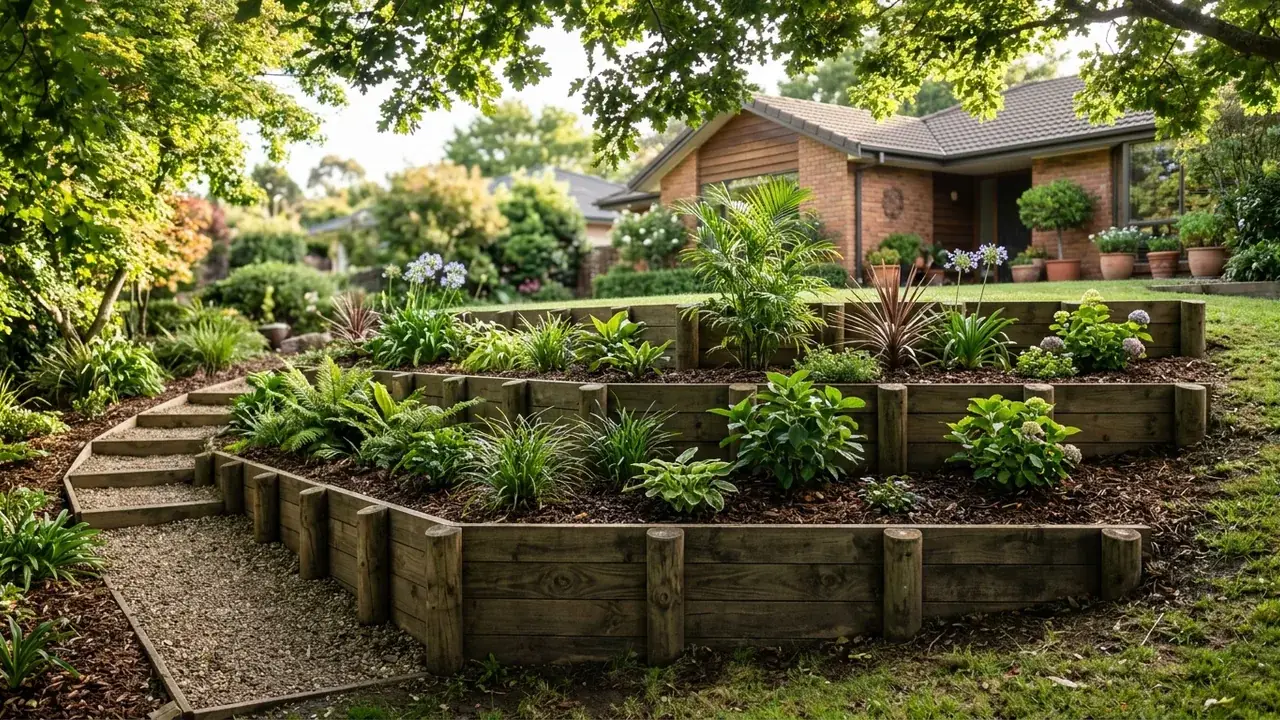
Timber sleepers are the cheapest honest way to hold a small change of level. A stepped garden bed, a low edge along a path, a terrace that turns an awkward slope into two flat strips of lawn. If the wall is well under a metre, nothing is loading the ground above it, and the job is landscaping rather than structure, this is a sensible place to spend less.
Two grades come up. H4 treated pine is treated to a level rated for in-ground contact, which is the minimum that belongs below soil, and hardwood sleepers cost more but wear better at the ground line. What matters is the boundary between those jobs and the ones where timber quietly costs you twice. Timber is also the one wall type where the right answer is often to spend less rather than more.
Timber Sleeper Retaining Walls and What They Cover
H4 treated pine sleeper walls
Treated pine rated H4 for in-ground use, set behind timber or steel posts. The treatment level matters more than the timber does, because anything below H4 is not rated for permanent soil contact and will go at the ground line first.
Hardwood sleeper walls
Denser hardwood sleepers cost more per metre and hold their shape better against bowing. They suit exposed runs, walls that get direct sun and rain in turn, and situations where the timber look matters visually rather than only structurally.
Terraced garden beds
Two or three low steps instead of one taller face. Terracing keeps each wall small, spreads the fall, and creates plantable ground, though walls set close to each other bring their own approval considerations that need checking early.
Drainage even at low height
A short wall still holds wet soil. Gravel and a perforated agi pipe behind the boards, with geofabric keeping clay out of the gravel, stop water sitting against timber that will rot faster once it stays damp.
How a timber wall actually fails
Timber does not fail all at once. It fails at the ground line, where the post is alternately wet and dry, and it fails from behind, where trapped water keeps the back face saturated. Everything you see later is downstream of that. Posts soften, the wall starts to lean out at the top, the sleepers bow between posts, and soil begins to drop away behind the face as the wall gives ground.
Brisbane has a lot of this stock. Interwar and post-war houses across Ashgrove, Holland Park, Coorparoo and Camp Hill sit on benches that were hand-cut into the slope, and the timber walls holding those cuts are now thirty to sixty years old. Most are not failing because they were built badly. They are failing because timber has a service life and theirs has run out.
Shallow posts are the other repeat offender. A post set too short simply pivots in the ground when the soil behind gets heavy, and no amount of new boards fixes that. Which is why replacing rotten sleepers on sound posts is a genuine repair, and replacing sleepers on soft posts is putting new timber on a wall that has already lost.
The point where cheap gets expensive
As an indicative guide, installed timber sleeper walls generally run around $300 to $450 per square metre of wall face, materials and labour, usually excluding GST, excavation, drainage, backfill and any engineering. Concrete sleeper sits considerably higher. On a small garden terrace that gap is small money and timber wins comfortably. On a taller structural wall the gap is real money, but so is the cost of doing the job twice.
The second build is always dearer than the first, because it carries demolition, spoil removal and the drainage remediation that should have happened the first time. So the question is not which material is cheaper. It is whether this wall is being asked to do a job timber can hold for its full life. These bands are indicative only, and a written quote with the exclusions itemised is what turns them into a real comparison.
There is a licensing point that catches people out, and it has nothing to do with height. QBCC licensing is triggered by the dollar value of the building work, not by how tall the wall is. A low wall that needs no building approval can still be work that a licensed contractor has to carry out. The two questions are separate and are worth keeping separate in your head.
Getting a timber terrace built properly
- 1
Confirm the wall is non-structural
Check nothing sits in the ground above the wall that would load it: no driveway, no shed slab, no pool fence, no second wall close by. If any of those are present, timber sleeper stops being the simple answer.
- 2
Pick the timber for the exposure
H4 pine for standard garden work, hardwood where the run is long, exposed, or where bowing between posts would be obvious. This choice is made against the setting, not against a catalogue.
- 3
Dig posts before you count boards
Post holes and depth determine whether the wall stands for its full service life. Boards are the cheap part of the job and the part everyone counts first, which is exactly the wrong way round.
- 4
Gravel behind, grade in front
Free-draining gravel and an agi line behind the sleepers, geofabric between gravel and clay, then surface fall directed away from the top of the wall so rain does not sheet straight into the backfill.
Timber done honestly
H4 is the floor, not a feature
Anything going into the ground should be rated H4 at minimum, which is the treatment level intended for permanent soil contact. A quote that just says treated pine has not told you the thing that decides how long the wall lasts, so it is fair to ask which rating is being supplied.
No upsell into concrete here
For low, non-structural garden terracing with nothing loading the ground above, timber is a reasonable spend and the rate per square metre reflects that. The case for a heavier system is made on height, load and expected life, and if none of those apply to your wall, none of them apply.
Rot at the base is a post question
Soft, spongy timber at ground level tells you where to look next. If the posts are sound, new boards are a real repair. If the posts have gone, new boards buy a season or two on a wall that has already lost its argument with the soil behind it.
Working through the options? The besser block retaining walls and concrete sleeper retaining walls pages cover the two nearest alternatives, and the cost calculator puts an indicative band against each of them.
Common questions about timber sleeper walls
How much does a retaining wall cost in Brisbane?
What is the cheapest type of retaining wall?
How much per metre is a retaining wall?
Can I replace my old timber retaining wall with concrete sleepers?
How much does a concrete sleeper retaining wall cost in Brisbane?
Tell us about your timber wall
A rough height, a rough length and a note on whether anything sits above it is enough to get a written quote started.
Timber Sleeper Retaining Walls across Brisbane
Terrain, access and building stock change what timber sleeper retaining walls look like from one part of Brisbane to the next. Pick your suburb for the local notes.
Garden terracing and low walls
Get a written quote for timber sleeper retaining walls
Send the height, the length and what sits above the wall, and you will get a written response covering timber sleeper retaining walls.